| Home | Contact Us | Site Map | Search |



|
|
||||
|
|
|
|
|
|
||||
 Back to: Clinical Center Home Page > About the Clinical Center > News and Events
|
|
| |
|
|
This file is provided for reference purposes only. It was current when it was produced, but it is no longer maintained and may now be out of date. Persons with disabilities having difficulty accessing information may contact us for assistance. For reliable, current information on this and other health topics, we recommend consulting the NIH Clinical Center at http://www.cc.nih.gov/.
|
|
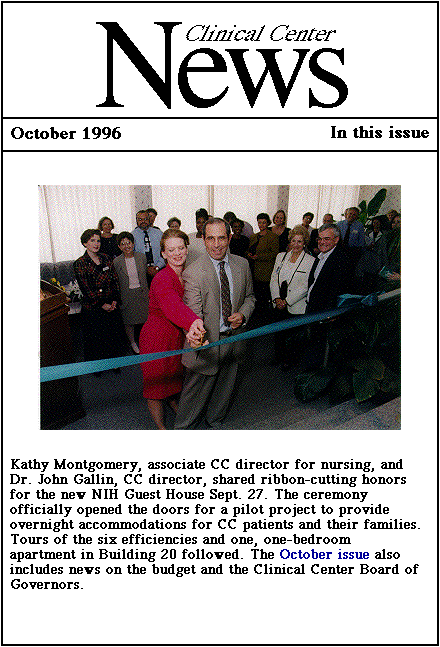
Guest house openingKathy Montgomery, associate CC director for nursing, and Dr. John Gallin, CC director, shared ribbon-cutting honors for the new NIH Guest House Sept. 27. The ceremony officially opened the doors for a pilot project to provide overnight accommodations for CC patients and their families. Tours of the six efficiencies and one, one-bedroom apartment in Building 20 followed. The October issue also includes news on the budget and the Clinical Center Board of Governors.CC News: October 1996In This IssueCC board to convene here on Oct. 21EEO pilot begins at CCClinical research issues before CongressObservance spotlights "Ability for hire"briefs:
Staffers experience Atlanta's Summer GamesFlu shots-- autumn's rite of passageMFP continues this month
CC board to convene here on Oct. 21The Clinical Center's new 17-member Board of Governors is expected to convene for the first time here on Oct. 21.Appointed by HHS Secretary Donna Shalala, the board will advise the NIH and CC directors on aspects of Clinical Center operations and management, including budget and strategic plans. Changing how the CC is governed topped the list of recommendations contained in a report to Shalala earlier this year. An Options Team she put together had spent most of 1995 scrutinizing the CC's structure and organization as part of Vice President Gore's Reinventing Government II initiative.
A collection of NIH committees and groups has historically governed the
CC. Their names were not available for publication at press time.
EEO pilot begins at CCThe Clinical Center is among the first groups at NIH to test a new system for handling the initial stages of equal-opportunity complaints.That means faster investigations of allegations, improved and streamlined communications, and the chance for quicker resolution for CC employees who feel that they have been discriminated against or sexually harassed. Joining the CC in the pilot, which began Sept. 15, are the NIH Office of the Director, the Office of Research Resources, and NCI. There is an informal and a formal process for dealing with allegations of discrimination and harassment, explains Carl Lucas, chief of the CC Office of Equal Employment Opportunity (EEO). It's the informal, or pre-complaint, phase that the Clinical Center and other pilot participants will handle. During the informal stage, he says, EEO counselors investigate specific allegations and talk with everyone involved. Most problems, Lucas points out, are settled in this phase. If not, the person with the complaint can move into the formal phase of the process, which is handled by the NIH Office of Equal Opportunity (OEO), for resolution. "We have more of a vested interest in taking care of our own, to quickly settle disputes," Lucas says. "This new approach also gives us more of an opportunity to become involved before a situation evolves into a formal complaint." Conflict resolution-the earlier in the process the better--is crucial. "Most of the time, complaints arise from a breakdown in communications. We in EEO don't take sides, and we serve all employees, managers and staff. NIH developed this pilot project to give the ICDs more flexibility in doing business," he added. In the past, employees with a complaint would take it directly to the NIH Office of Equal Opportunity's complaints management and adjudication branch. An NIH EEO counselor would, in the informal phase of the process, investigate and prepare a report for NIH OEO review in the formal phase. "Historically, we at the Clinical Center would help the assigned counselor conduct the investigation and handle paperwork," he said. In preparation for their new roles, three staff EEO specialists and seven counselors recruited from throughout the Clinical Center have had special training in how to mediate conflict and formally lodge complaints found to be legitimate. The NIH OEO staff will work with the CC counselors on the initial cases. (by Sara Byars) Go To The Clinical Center Office of Equal Opportunity & Diversity Management (OEODM) Web Page
Clinical research issues before Congressby Dr. John I. Gallin, CC DirectorIt's an exciting time for clinical research and we at the Clinical Center have an enormous stake in several issues before Congress this fall.The Office of Management and Budget has said that it expects that the Clinical Center will generate some $18 million by collecting health-insurance payments for the routine care of patients in clinical trials here in FY97. Appropriations bills passed by the House of Representatives on July 12 and by the Senate Appropriations Committee on Sept. 12 authorize NIH to collect this money and credit it to the NIH Management Fund. The Clinical Center does not receive a separate budget. Our budget comes from the institutes through this management fund. Tapping this pool of health-care dollars isn't a new--or particularly simple-idea. In order for it to work effectively, we must:
Another bill before Congress reinforces the importance of clinical research to American's health. The Clinical Research Enhancement Act of 1996, which has become a part of the NIH Revitalization Act of 1996, acknowledges that clinical research is crucial to expanding scientific knowledge and developing new and better ways to treat disease. If passed, this bill would allow NIH to establish an intramural clinical research fellowship program and a continuing education clinical research training program. Finally, both the House and the Senate agree on the need to continue to fund construction of the new Clinical Research Center. Bills now before Congress earmark about $90 million for the new facility in FY97. While we had hoped that Congress would approve the plan to fund the entire $310 million project in FY97, as outlined in President Clinton's budget request earlier this year, Congressional support for the new center is clear. Naming the new Clinical Research Center for Sen. Mark O. Hatfield (R-Oregon) was included as an amendment to the Senate appropriations bill awaiting a final vote as this issue of CCNews goes to press, and it's anticipated that it will be included in the final funding bill. Sen. Hatfield has long been a proponent of biomedical and clinical research. Under his chairmanship of the Senate appropriations committee, funding for NIH has increased by more than $2.5 billion. Last year he led Congress in maintaining overwhelming support for biomedical research by offering an amendment to the budget resolution that spared NIH from a 10 percent cut in funding.
All of this is good news for clinical research in general and the Clinical
Center in particular.
Observance spotlights "Ability for hire"Celebrating October as National Disability Employment Awareness Month offers an opportunity to look at how the CC Disability Employment Program benefits employees with and without disabilities. The CC Office of Equal Employment Opportunity (EEO) develops and manages the program. Its primary mission is to advance the employment of persons with disabilities.Theme for this year's observance is "Ability for Hire." Persons with disabilities work on Main Street and on Wall Street. They are trained accountants, bricklayers, scientists, chefs, dishwashers, radio announcers--the list goes on. Their skills and talents are needed and their abilities are for hire. Improved accessibility and acceptance has resulted in more job opportunities for persons with disabilities. In the CC EEO office, Jerry Garmany coordinates the Disability Employment Program, which ensures reasonable accommodations, often making it possible for a qualified person with a disability to do the same job as anyone else, but in a slightly different way. Some accommodations are simple adaptations. Others require technically sophisticated equipment. The EEO office also coordinates requests for sign-language interpretation for deaf applicants, employees, and patients, and provides Teletypewriter (TTY) devices to deaf or hard-of-hearing employees.
For program details, contact Garmany at 496-9100 (TTY), through the Maryland
Relay Service on 1-800-735-2258, or e-mail him, jgarmany@pop.cc.nih.gov
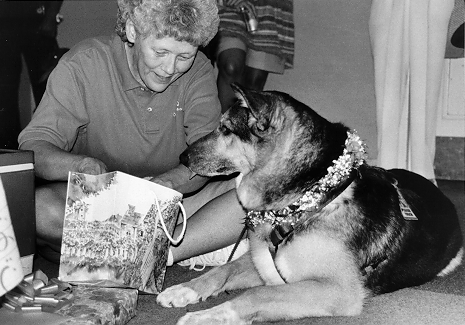
A caring canineWearing a flowered lei and basking in the affection of co-workers, Samantha, a German shepherd, was honored with a reception commemorating her retirement last month as a Caring Canine. Joining Samantha was her owner, Jane Bartholomew. Samantha is one of the original Caring Canines of the National Capital Therapy Dogs, Inc. She and her colleagues are volunteers--as are their owners--who visit with patients at the Clinical Center and other hospitals.
briefs:Pumpkin Chase ready to take offThe 5th annual Great Pumpkin Chase set for Sunday, Oct. 27, will benefit the Friends of the Clinical Center (FOCC). The 5K run and one-mile walk will be sponsored by the NIH Federal Credit Union and radio station WKYS. Individuals and teams can sign up for the races.
There'll be t-shirts for participants, prizes in several categories, and
refreshments. For more information on the Pumpkin Chase, call Wendy Ladas
at 230-4817. To sign up as an FOCC volunteer to help with the event, call
Pat Turner at 496-9271.
Classes on tap for NovemberCall 496-1618 to register for these November classes:
String concert series returnsThe Manchester String Quartet Series returns for its eighth season on Oct. 21. The concert series is presented 12:30-1:30 p.m. in Masur Auditorium. Concerts are also set for Nov. 4, Dec. 9, Jan. 13, Feb. 10, March 3, April 7, and May 19. Call Sharon Greenwell at 496-4713 for more information.
Learn about difficult peopleThe NIH Employee Assistance Program's video workshop series opens Oct. 15 with "How to Deal with Difficult People." Program counselors will lead a group discussion following the video.The series--Tuesdays at the Little Theater-is free, open to all employees, and requires no reservations. Just drop by the Little Theater, which is in the Visitor Information Center, at noon. Sessions run an hour. Other programs will be offered Oct. 22, and Nov. 5, 12, and 19. Call 496-3164 for details.
RNA symposium set this monthThe NIH RNA Club will host the Mid-Atlantic Regional RNA Symposium on Oct. 22. Sessions will begin in the Natcher Conference Center at 9 a.m. Tom Blumenthal of Indiana University will present the keynote address, "Operons in the Nematode Genome." Platform talks will focus on RNA metabolism and RNA-protein interactions. For registration details, access the symposium web site, http://www.nci.nih.gov/intra/LTVB/symp.htm.
Town meeting setDr. John Gallin, CC director, will convene a town meeting for CC employees Nov. 4 at 2 p.m. in Masur Auditorium. Among the topics on the agenda is a report on the first meeting of the Clinical Center Board of Governors, which is set for Oct. 21. Dr. Gallin will also discuss the CC strategic plan and ongoing Clinical Center initiatives.
Cafeteria closingThe 2nd floor cafeteria is slated to close Oct. 19, according to DES space management officials, so that the CC Nutrition Department can use the kitchen while their own is undergoing ceiling repairs. GSI is expected to increase staffing in the B1 cafeteria. The repair project is expected to take several months.Other changes during the relocation:
Leave scheduling updates announcedEffective Oct. 1, employees will no longer be required to use their accrued annual leave during the leave year prior to using any restored leave previously credited. Restored leave and regular annual leave may be used in any order the employee wishes.According to HHS, this includes any leave restored to employees as result of the furlough, which employees have until January 1999 to use.
And speaking of leave, employees with use-or-lose leave have until Nov.
23 to schedule a time to take it.
Receipts help CC schoolYour Giant and Safeway grocery receipts added up to a new television for the Clinical Center school last year. The school participates in the local equipment-for-receipts exchange program, which has meant books, computer software, and supplies for the school-away-from-home for CC patients.
Located on the 10th floor, the school is classroom to more than 300 students
each year. If you'd like to help enhance the program, drop off the receipts
or send them to room 10S235.
Worksite health program offers examNeed a mammogram? George Washington University's Breast Care Center and the NIH Worksite Health Promotion Program will make it easy to arrange.The center's mammography van will be in the parking lot behind EPS and EPN on Executive Blvd. Oct. 30; on Convent Drive near the CC on Oct. 31; and at Natcher on Nov. 6. Hours are 8:30 a.m.-4 p.m.
The mammography costs $75. The mobile program is accredited by the American
College of Radiology. To schedule an appointment, call (202) 994-9999. Call
Susanne Strickland at 496-1105 if you have general comments or suggestions
about the worksite mammography program or other initiatives offered by the
Worksite Health Promotion Plan.
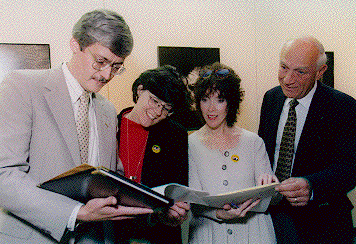
Campaign beginsThe annual Combined Federal Campaign kicked off this month and Clinical Center key workers will be sharing information about the program with co-workers throughout the next few months. Theme for this year's campaign, led at the Clinical Center by Walter Jones, CC deputy director for management and operations, is "Help Hope Take Shape." Warren Moyer (pictured left), CC management analyst and a campaign coordinator, talked with Monica Restrepo, Nursing Department, and Mary Vailati, Clinical Pathology Department, during a recent meeting for departmental key workers. With them is Dan Carney, a campaign executive on loan from the Treasury Department. Carney led some of the training sessions.
Ann McNemar (pictured right), a nurse on 9 West, had a behind-the-scenes,
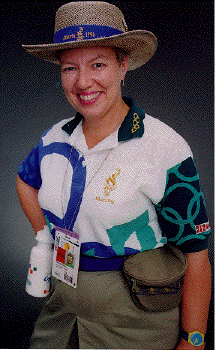
front-row seat to the Staffers experience Atlanta's Summer GamesWhile the world waited for Atlanta's summer games to begin, three Clinical Center dietitians were mobilizing to answer a call for help from Olympic organizers.Pam Brye, manager of patient services for the CC Nutrition Department and PHS chief dietitian, received the call. The Public Health Service was needed to help with food inspections provided by the Fulton, Ga., health department. That was Saturday morning. By Tuesday, Brye was in Atlanta, along with CC research dietitians Melissa Zafonte and Rosemary Parisi. They joined a cadre of federal sanitarians, dietitians-and one veterinarian--from ten states. Hundreds of vendors were licensed to sell meals and snacks on the streets of Atlanta. Olympic planners had underestimated the number of sanitarians needed to make sure that the food was safe. Huge crowds and hot temperatures made that monitoring crucial. "There was great potential for food-borne outbreaks of illness," pointed out Brye, who staffed the food inspection command post. Zafonte and Parisi joined teams that worked two shifts a day performing the inspections. "The team members made sure that foods were kept at the correct temperature, that handwashing and toilet facilities were available, and that the vendors had the proper permits," Brye explained. "The teams were responsible for specific areas. My team covered the area around Centennial Park," said Zafonte. "The vendors in this area had proper permits, but we had the authority to shut down anyone not in compliance." SWAT teams were called in when a food vendor was ordered to shut down and didn't. "The streets had a carnival atmosphere," noted Parisi. "When people bought food from a street vendor, there was nowhere to sit, except on the curb. But the city needed the vendors during the Games--the permits meant income for the city." "When a vendor applied for a permit, there was no way to know if they had had training in food handling," Brye added. "Many of those vendors had invested thousands of dollars and were making only hundreds," said Zafonte. "People weren't buying." That made the inspectors easy targets for the vendors' frustrations. "They saw us often and they sometimes vented their frustration on us. But they also understood that we had a lot of people to protect," Zafonte explained. The teams performed about 3,400 inspections during their 10 days in Atlanta. They responded to 49 complaints and mounted six food-borne illness investigations. More than 20,000 pounds of food had to be discarded as result of their inspections, including nearly 11,000 pounds of quiche. "This was the first time that dietitians have been called to participate in an emergency effort," said Brye.
"The experience put a new perspective on our profession's role in the
PHS," Zafonte said. "We, too, are public servants." She was afraid of horses and climbed up on one only because she was too embarrassed to tell the riding instructor she hadn't come for lessons. "I had tagged along with a group of friends who wanted to learn to ride. The teacher assumed I did, too," explains Ann McNemar, laughing. And for the reluctant student, riding became a life-long love and her ticket to an up-close, behind-the-scenes look at Olympic competition. McNemar, a nurse on 9 West, was tapped as a scoring assistant for the equestrian competition during the Summer Games in Atlanta. When the call for applications for volunteers appeared in an equestrian magazine three years ago, friends encouraged her to apply. She was one of about 20 accepted. "In many ways, scoring at the Olympics was easy," admits the veteran scorer for local events. "There's a lot more technical support." Timing information, penalties at cross-country fences, and movement scores during the dressage events were entered into timing equipment linked to computers, which reformatted the data for television and the commentators, and printed the results. Everything was also recorded by hand so that manual and electronic scores could be compared before the final results were published. During grand prix jumping, McNemar oversaw the manual scoring master sheet. On endurance days, she was one of two scorers for the steeple chase events. For dressage events--competitions in which the horses move through a series of specific movements--she served as a computer scribe. "I fed the scores directly into the computer," she says. "I was very nervous about doing it right. Once the whole screen disappeared! I certainly have a better appreciation as to what goes on behind the scenes." The weather and security concerns topped the agenda of behind-the-scenes worries for Olympic participants. "Having the games in Atlanta spurred a world-wide research effort on horse and heat-related issues," McNemar says. "A good bit of data was developed." Because of the South's sultry summer weather, the cross-country course was shortened, rest stops added, and mist machines installed. "Competitions started early and ran late, with breaks during the middle of the day. Weather sensors and temperature monitors were in place and the competitions would have been stopped if necessary." Heightened security meant thorough inspections of vehicles and individuals coming in for the competitions. "I kept hearing people talk about sanitizing things. I thought they were talking about ticks on the horses, but it turned out to be for bombs." McNemar's involvement in international competitions didn't end with last summer's Olympics. She'll be involved in next year's North American dressage event and plans to attend the world equestrian championship in Ireland in 1998.
She and her horse Avenue may participate in some local games as well. "I
don't love jumping that much because I'm becoming breakable," she says
with a laugh. "Avenue knows more than I do and I'm learning from her.
We'll compete once we both figure it all out." (-by Sara
Byars)
Foil the flu Flu shots -- autumn's rite of passageFor more than a decade, the Occupational Medical Service (OMS) has offered free influenza immunizations to NIH employees. Knowing how important it was to be protected from this virus, more than 5,000 NIH employees got vaccinated by OMS last year. Do you need a flu shot this year?Last year, five patients being treated at the CC were later diagnosed with the flu. During the course of caring for them, 90 health-care workers and support staff were exposed to the virus. Twenty-five hadn't been vaccinated and went to OMS for evaluation; at least six developed the flu. That's why an annual flu shot is important. If many hospital workers become incapacitated, patient care could suffer. You can't predict where you will be exposed to influenza, whether at home, in your community, or at work. Because you work in a hospital, disease prevention experts recommend that you get an annual flu shot. By doing this, you can help prevent this highly contagious virus from spreading among high-risk persons such as the elderly and those with underlying health problems. If you received a vaccination in the past, you still need to be vaccinated because influenza viruses change every year. The vaccine is made of safe, inactive particles that cannot cause influenza.
To make it convenient for patient-care employees in building 10, OMS will
administer shots for these workers on various nursing units from 6:30-11:30
a.m. and 4-6 p.m. on Oct. 7, 9, and 11. Watch for posters in clinics and
patient-care units for times and places.
MFP continues this monthThe Clinical Center's 1996 Medicine for the Public lecture series begins Oct. 1.The lectures, which are free and open to the public, are held at 7 p.m. on Tuesdays in Masur Auditorium. This year's schedule:
Comments? webmaster@cc.nih.gov
National Institutes of Health (NIH) Warren Grant Magnuson Clinical Center (CC) Bethesda, Maryland 20892 Last modified 10/31/05

|
|
|

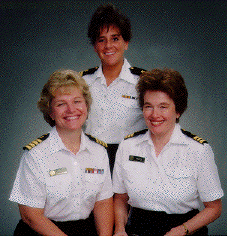 Pam Brye, Melissa Zafonte, and Rosemary Parisi