|
|
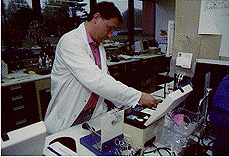 |
Bob Butz, medical technologist
with the Department of Transfusion Medicine's cell processing section, uses
a sterile connecting device to link the tubing between two blood bags. The
new cell processing facility was built with the help of a cooperative research
and development agreement with Baxter Healthcare Corporation.
|
New DTM facility will manufacture components for cellular therapies
With the debut of its new cell processing facility, the Department
of Transfusion Medicine (DTM) offers scaled-up manufacture of a broad range
of components for cellular therapies such as gene therapy, hematopoietic
(stem) cell transplantation, and immunotherapy.
The 3,000-square-foot facility was built with the help of
a cooperative research and development agreement with Baxter Healthcare
Corporation. Goals are developing and improving procedures for collecting,
modifying, growing, and preserving human cellular components.
The lab caps more than a decade of support DTM has given investigators
who seek novel cellular therapies.
"We've been approached by just about every institute
with ideas and plans for protocols for the next five to 10 years,"
said Dr. Elizabeth Read, cell processing section chief. "This facility
was designed to meet the anticipated increased workload as well as the Food
and Drug Administration's (FDA) regulatory requirements for a biologics
production facility."
A biologic is a treatment derived from a living organism,
for example, a vaccine. The manipulation of human cellular and tissue-based
products is receiving increased scrutiny by the FDA.
In addition to manufacturing a variety of cell products (see
sidebar at left below), the cell processing section is developing methods
and devices to improve consistency and efficiency of processing, said Dr.
Read. Automation, tracking, labeling, and equipment are all crucial to the
process of manipulating billions of cells according to the specifications
of many different protocols.
"We are striving to provide a consistent product to the
patient, despite all the complexity, so that the investigator will get the
anticipated results and everybody will trust the data," she said.
An ongoing pursuit that drives much of the research is to
"close the system" of cell-product manufacture (see sidebar at
right below). A closed system would be one in which the cellular products
go from patient to lab and back to patient without being exposed to environmental
contaminants.
"It's possible we will always have some openness in our
system," Dr. Read explained, "but our goal is to try to close
things up because it significantly reduces the chances of microbial contamination."
Thanks to DTM research, much of the cell processing is now
done in plastic blood bags linked by plastic tubing. The lab sports a new
$8,000 device that makes sterile welds between two pieces of tubing. "It's
one of the stars of our show,"Dr. Read said.
Environmental features in the spacious lab include a dedicated
air-handling system, culture rooms for cell incubation, and easy-to-clean,
dust-repellent surfaces. On June 16 from 9:30 to 11 a.m., members of the
media will tour the new lab. By the end of this month, however, access will
be restricted to maintain the lab's pristine environment. (by Sue Kendall) |
Attention clinical investigators:
The cell processing section produces a wide variety of cellular products
for NIH clinical trials. A few examples:
For gene therapy:
·gene-transduced lymphocytes
·gene-transduced hematopoietic stem cells
For hematopoietic therapy:
·hematopoietic stem cells from bone marrow or blood
·T-cell depleted hematopoietic stem cells
For immunotherapy:
·peptide-pulsed antigen presenting cells
·peptide-activated lymphocytes
|
Cell processing made simple:
These basic steps are involved in most cell processing protocols. Thanks
to years of DTM research, the process can largely be done with plastic tubing
and blood bags to reduce microbial contamination.
Apheresis: Removing a blood component from the patient, usually
white blood cells, while returning the remainder of the blood to the patient
or donor.
Separation: Separating the cell type into subtypes by size, density,
or other characteristic.
Culture: Growing the cells under controlled conditions in the
lab.
Modification: Treating the cells in some way, e.g., introducing
a corrective gene to give the cells a new function, or stimulating them
with a growth factor.
Expansion: A type of culture that greatly increases the number
of cells.
Reinfusion: Giving the processed cells back to the patient.
In all clinical protocols, the patient is closely monitored for signs
of disease improvement and side effects of the therapy.
index |
Early retirement an option for
some employees
|
Eligible Clinical Center employees have until Sept. 1 to take advantage
of a voluntary early retirement program.
"The CC would like to use the Voluntary Early Retirement Authority
to continue its restructuring plan for the Clinical Center, in particular
the reduction of overall costs," said Dr. John I. Gallin, CC director,
in announcing the authority, which was approved for NIH by the Department
of Health and Human Services.
Although the Clinical Center is on track in FTE targets for the current
fiscal year, the early-retirement option offers another management tool
to meet long-term financial targets, explained Tom Reed, chief of the Office
of Human Resources Management.
The early-retirement option is available to eligible employees who formally
apply by no later than Sept. 1 and retire by Sept. 30.
To be eligible, applicants must be at least 50 years old with 20 years
of service or any age with 25 years of service.
The program is open only to employees with at least five years of civilian
service (continuous service in HHS since July 21, 1996) and who are not
on a time-limited appointment.
Some specifics for prospective early retirees:
--Civil Service Retirement System (CSRS) employees receive annuities
permanently reduced by 2 percent for each year they are under age 55. Federal
Employees Retirement System (FERS) employees who had a period of employment
under CSRS have the CSRS portion of the annuity computation reduced by
2 percent for each year under age 55.
--Social Security benefits for CSRS retirees may be reduced under the
Windfall Elimination Provision or the Government Pension Offset. Local
Social Security offices can provide more information on that.
--Unused sick leave can't be counted toward retirement eligibility.
CSRS employees eligible to retire receive credit for unused sick leave
in their annuity computation. Annuity computations for FERS employees don't
include credit for unused sick leave. Retirees receive a lump sum payment
for unused annual leave.
--Retirees who have had continuous coverage for the five years immediately
preceding retirement or since their first opportunity to enroll may elect
to continue current health and life insurance plans.
--Any federal service following voluntary early retirement must be as
a re-employed annuitant with salary reduced by the amount of the annuity.
--Retirees who have a Thrift Savings Plan account of more than $3,500
and are entitled to an immediate CSRS or FERS annuity may transfer the
account balance to an IRA or other eligible retirement plan; receive the
balance in a lump sum or equal monthly installments; purchase a life annuity;
or decide later what to do.
Personnel office staff are available to help fill out the application
papers and to answer questions about the early-retirement application process.
Call 496-6924.
index |
From the director:
by Dr. John I. Gallin, CC director |
Performance and responsiveness as an organization are crucial foundations
for the Clinical Center.
But how do we gauge those factors? Surveys provide one option. HHS Secretary
Shalala commissioned a department-wide survey earlier this year that provides
some insight into what we do well as an organization and what we need to
improve upon.
NIH received general high marks on the quality of work-life issues. Specifically,
the Clinical Center's strengths included performance feedback, management
practices, and feelings about our organization.
People who work here know our hospital is a special place and that our
mission is an important one. That comes as no surprise to me. I see that
pride and commitment every day. Our patients accept it as a fact of life.
As an organization, the survey revealed, we do a good job letting people
know when they've done a good job and guiding workers who need assistance
in performing at their peak. The survey also indicates that our co-workers
and colleagues have confidence in the Clinical Center's management practices.
There are some issues we must address. The survey noted some degree of
discontent within work groups that affects employee morale. This is a pivotal
era of growth and change for the Clinical Center, and we have to offer our
employees the tools and support they need to work productively and with
personal satisfaction.
We also have to encourage discussion and development of new ways of accomplishing
our work, another area for improvement revealed in the survey.
To improve our organization's performance in these areas, I need your
ideas. I welcome departmental invitations for group discussions over brown-bag
lunches. Send your ideas, questions, and comments to me directly by email
(jgallin@cc.nih.gov). I'm initiating in this issue of CCNews a fax-back
option for those of you who'd like to use that medium to tell me what's
on your mind.
You, the individuals who make up the Clinical Center's remarkable team,
define the issues, articulate the concerns, and ultimately answer the questions
of how to do things better. Please let me hear from you.
index |
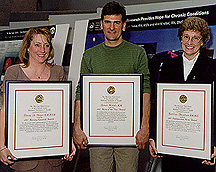
Among Nursing Department
members honored at a recent awards day ceremony were (from left) Donna Jo
Mayo, nursing research award; James Nichols, nurse of the year; and Kathleen
Musallam, distinguished nurse of the year.
|
Ceremonies honor nursing award recipients
Nursing Department honored its members with an awards ceremony May 5.
James Nichols was named 1997 nurse of the year and Kathleen Musallam
received this year's distinguished nurse award. The nursing research award
went to Donna Jo Mayo.
Nichols was honored for outstanding contributions to clinical care, coordination
of the multidisciplinary team, and for promoting patient and family participation
in care decision-making.
Musallam's award recognized her contributions in gerontology and Alzheimer's
disease, and "serving the elderly and mentally disabled in the community
as an advocate and by monitoring their health and assisting them to make
informed health-care decisions."
Mayo's award was for the design and implementation of two studies, "Accuracy
of Coagulation Studies Obtained from Heparinized, Double Lumen Hickman Catheters"
and "Evaluation of the Effect of Routine Heparinized Flush Solution
in Groshong Catheters."
A director's award in administrative services went to Olga Asadi, Arlene
Brooks, Ana Ferreira, Linda Fitzwater, Susan Harris, Kathleen Krisko, Loan
Kusterbeck, Linda Linko, Patsy McCabe, Cindy Petruso, Norman Pickett, Eugene
Reid, Rita Richey, and Marsha Short. The group was honored for "accepting
new challenges, embracing a risk, and working toward improved customer service
in the administration of the Nursing Department."
The department's Collaborative Practice Model Team was also honored with
a director's award. Team members are Diane Aker, Barbara Corey, Maureen
Edgerly, Andrea Gillespie, Donna Marchigiani, Susan Sandelli, M. Claire
Walsek, Patricia Whitcomb, Myra Woolery-Antill, Janice Yates, Kathleen Zimmerman,
and Sheryl Zwerski.
They were recognized for the "development and piloting of a model
of collaborative practice, which created a focus on better service within
the pediatric oncology population."
Recognized for clinical excellence were Rubi Defensor, Bethany Royal,
Earlian Smith-Jackson, and Mary Tully.
Honored for excellence in leadership were Susan Johnson, Victoria Liberty,
and Lori McIntyre.
Awards for excellence in administrative an clinical support was given
to Alicia Garrison and Gloria Jean Rodriquez.
Receiving awards for excellence in teamwork were Donna Jo Mayo and Deborah
Gutierrez; Lillie Fairchild, Kiya Green, Doris Lewis, and Nancy Stefan;
the 3 East and 4 East nursing staff; 4 West nursing staff; and the Rainbow
Team.
Honored for excellence in nursing patient education were Juanita Tejada
and Janice Yates.
Service chiefs' awards went to Bertram Brown, Kim Cox, Jeanne Radcliffe,
Susan Squires, Myra Woolery-Antill, and the 13 East outpatient cancer center
staff.
index |
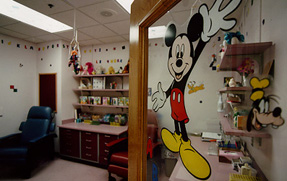
A child-sized
Mickey Mouse waves a welcome to a specially decorated room for the Clinical
Center's littlest patients. |
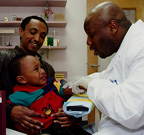
| Gourdine assures Abdulkadir--and
dad--that they are in good hands. |
|
|
Phlebotomy team puts littlest patients at ease
Richard Gourdine is a big guy. American Gladiator big. Heavy-weight boxer
big. But Gourdine has a soft touch, and it's his gentle technique that allows
little ones to have their blood drawn with little fear.
Knowing that children come to them already frightened of needles, Gourdine
and his phlebotomy co-workers, Clara White and Linda Arnett, put their imaginations
and experience together and decided they could make it easier for children
to get blood drawn.
After years of calming kids and sticking those tiny veins just right,
they created a special child-friendly room where fears are replaced with
smiles and trust.
Cartoon characters line the walls, clowns hang on swings from the ceiling,
and colorful footprint stickers guide tiny patients into the room.
"This is a way of distracting them," says White. "They
see characters they're already familiar with and it calms them."
Spending weekends and evenings and some of their own money, the three
phlebotomists turned a once-sterile and frightening procedure room into
something inviting and gentle.
"The kids are not as afraid when the see all the Disney characters,"
Arnett explains. "Other patients waiting would hear the crying and
then they would get upset. Now they hear laughing and giggling."
Patient phlebotomy is generally the first contact patients have when
they come to NIH," says Gourdine. "And it's important to us that
our patients don't start out with undue stress."
To first see Gourdine is to notice the size of his biceps, but when you
speak with him about children and his work you notice his heart is his biggest
muscle. As he puts it, "When a friend draws your blood, it makes things
better." (by Laura Bradbard)
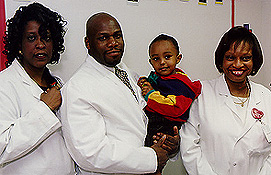 |
Clara White, Richard Gourdine,
and Linda Arnett convince Azam Abdulkadir that all is well in room 7.
index |
|
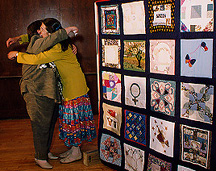
| Quilter Shirlee Mohiuddin of
Chicago and fabric artist Nancy LeGendre of Massachusetts (above) embraced
during the unveiling of their ovarian cancer survivors' quilt at the CC
last month. The two created the quilt using individual squares made by ovarian
cancer patients and caregivers from around the country |
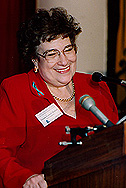
| Cancer survivor Susan Butler
(above) found a community of support and hope on the internet-a discovery
that ultimately led to the birth of the Ovarian Cancer Survivors' Quilt,
which was unveiled here last month. |
|
|
Quilters stitch a testament of hope and understanding
A double diagnosis of ovarian and breast cancer in 1995 and subsequent
treatment at the Clinical Center led Susan Butler to search the internet
for answers to the questions that kept her up at night.
The support group she found in cyberspace gave her a forum to ask questions,
share information, and spread hope and understanding to thousands of other
women going through the ovarian cancer nightmare.
Eventually, this meeting of the minds gave birth to the Ovarian Cancer
Survivors' Quilt-brainchild of ovarian cancer survivor and quilter Shirlee
Mohiuddin of Chicago. She, and fabric artist Nancy LeGendre of Massachusetts,
created a 6-foot-by-6-foot quilt of individual squares made by ovarian cancer
patients and caregivers from around the country.
When Butler suggested they present the quilt at an NIH ceremony she was
asked by the many participants how she could get the attention of such a
large institution. She answered, "I'll get their attention, because
I think they'll care."
Publicized on the ovarian cancer discussion list on the internet in the
spring of 1996, the quilt was recently unveiled at the Clinical Center.
Among ceremony attendees were other ovarian cancer patients and families
of patients; NCI physicians Dr. Eddie Reed and Dr. Elise Kohn; Dr. Charles
Rabson, NCI deputy director; and Dr. Vivian Pinn, director of the Office
of Research on Women's Health. Butler, Mohiuddin, and LeGendre met face
to face for the first time at the presentation.
After hanging in the CC lobby for a month, the quilt will begin a journey
to other health research and teaching centers to encourage ovarian cancer
patients and to raise awareness about this often silent disease and the
need for more research funding. (by Laura Bradbard)
index |
news briefs:
Board meeting set for July 10
The Clinical Center Board of Governors will meet at 9 a.m. on July 10
in the Medical Board Room.
The group is expected to consider the CC budget for the next fiscal year
and review priorities for the Clinical Center's strategic plan. At the board's
last meeting, which was Feb. 10, members endorsed the Clinical Center's
strategic plan and asked that the institutes be given an opportunity to
comment on priorities for the plan's individual projects.
Piscitelli honored
Dr. Stephen Piscitelli, CC Pharmacy Department, has received the 1997
American College of Clinical Pharmacy-Amgen Biotechnology Research Award
for his proposal, "Drug-Cytokine Interaction in HIV-Infected Patients."
The award will be formally presented during ACCP's annual meeting later
this year in Phoenix.
Ceremonies honor CC volunteers
Ceremonies were held recently to honor the Clinical Center's volunteers.
Receiving pins for 1,000 hours of service were Elaine Brill, Harry Canter,
Amparo Collazo, Mary Maze, Mary Partlow, and Louise Shiffrin. Honored with
pins for 2,000 hours service were Susan Canter, Catherine Freedberg, and
Susan Schap. Pins for 3,000 hours of service were presented to Dorothy Feelemyer,
Ganesh Kayastha, and Amanda Modlin.
Special recognition went to Floride Canter for 8,000 hours of volunteer
service. Canter was also recently honored as Montgomery County's Red Cross
volunteer who has contributed the most hours of service.
Training vouchers
The education and training section, Office of Human Resources Management,
has purchased vouchers from CompUSA for CC employees to use for computer
training at no cost to their department's training budget.
CompUSA offers a variety of Mac, PC, and internet courses at training
sites in Maryland and Virginia.
On-site courses (Mac only) will offer fundamental and intermediate training
in MSWord, Excel, and Powerpoint during May and June at 6100 Executive Boulevard.
Call 496-1618 for details. Vouchers must be used by June 26. |
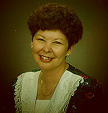
Awarded
Rogene Shank, personnel assistant in the Office of Human Resources Management,
has been named first recipient of the Outstanding Public Service Award given
by the Montgomery County Chapter of the International Personnel Management
Association. "She believes in the mission of the organization and goes
beyond the call of duty to uphold the image of the office," her nomination
read. "Anyone who comes to see her, no matter what the time or how
busy she is, receives her undivided attention, and a clear, well-researched,
prompt, responsive, and under-standable answer." Tom Reed, director
of human resouces, said "We're glad Rogene has been with us so long
and given such valuable service to her clients. She is a model employee
and one we are very proud of."
Seminar set
The Office of Aids Research will sponsor a seminar, "The T Cell
Receptor Repertoire in HIV and SIV Infection: Implications for CTL Persistence,
DC4 Turnover, and Vaccine Development," on June 16.
Dr. Rafick-Pierre Sekaly of the University of Montreal's Laboratory of
Immunology, will present the seminar at 1-2 p.m. in Lipsett Amphitheater.
For more information, contact Dr. Fulvia Veronese at 496-3677.
Apply now for research festival poster sessions
Registration has begun for the NIH Research Festival, which runs this
year from Oct. 6-10. The annual event spotlights the intramural program.
Dr. Allen Spiegel, NIDDK scientific director, chairs the 1997 organizing
committee.
Researchers interested in presenting posters at the festival must submit
applications by 5 p.m., Friday, June 13.
The week kicks off at the Natcher Conference Center on Monday, Oct. 6,
with a major symposium organized by the Immunology Interest Group. A second
symposium sponsored by the Structural Biology Interest Group follows on
Oct. 7. More than 300 posters will be displayed during four poster sessions
coordinated with more than 20 workshops developed by other inter-institute
interest groups.
The Office of Education hosts a Job Fair for NIH postdoctoral researchers
on Oct. 8. That afternoon the DeWitt Stetten Jr. Museum of Medical Research
co-sponsors a special symposium celebrating 60 years of intramural NIH science,
according to Dr. Spiegel. "In addition to Drs. Varmus, Gottesman, and
other NIH officials, there will be distinguished present and former NIH
intramural scientists, including Martin Rodbell, Eugene Braunwald, and Elizabeth
Neufeld."
Researchers from all ICDs are invited to submit applications to present
posters at the festival. Poster space is limited.
The easiest way to submit applications is through the festival Web site
(http://pubnet-mac.nih.gov/festival97/). Using a current browser supported
by DCRT, applicants simply fill in the web form and forward their information.
Authors are required to submit a brief abstract, but this year viewing access
to the abstracts is restricted to NIH users via the DCRT PubNet site.
Applicants may also submit entries via fax or email using the festival
application form distributed throughout intramural laboratories and offices.
For more information, contact Gregory Roa, 496-1776 or gr25v@nih.gov.
index |
top | cc
home page | nih home page
|
| Clinical Center News, Building
10, Room 1C255, National Institutes of Health, Bethesda, Maryland 20892.
(301) 496-2563. Fax: 402-2984. Published monthly for CC employees by the
Office of Clinical Center Communications, Colleen Henrichsen, chief. News,
articles ideas, calendar events, letters, and photographs are welcome. Deadline
for submission is the second Monday of each month. Editor: Sara Byars, sbyars@nih.gov. Staff Writers: Laura
Bradbard, Sue Kendall. |
|





 Back to: Clinical Center Home Page > About the Clinical Center > News and Events