Published monthly for CC employees by Clinical Center Communications/
January 1998
From file clerk to supervisor
DTM staffers honored
Farewell to building 20
Save those receipts!
Record sets a record
Learning to juggle
From the director
Briefs
CFC
|
|
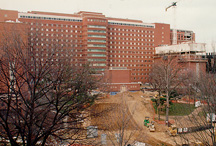
Construction
continues
The south entry will temporarily become the main entry to the Clinical
Center when the front entrance is closed for construction of the Mark O.
Hatfield Clinical Research Center. The proposed area will include a three-lane,
covered drop off area and sloping driveway.
CC introduces new program for local youth
If you're still looking for a New Year's resolution, here's an idea.
The CC Office of Equal Employment Opportunity (EEO) is currently developing
a mentoring program for local area high school and college students.
The program, which will be implemented next spring, came in response
to an increasing number of community requests for internship opportunities
at the NIH, as well as the CC's commitment to enhancing the field of clinical
research training.
"We hope that this initiative will encourage volunteerism among
CC staff, as well as increase students' awareness of careers in the research,
health care, and science environments," said Walter Jones, CC deputy
director for management and operations.
Program planners hope that all CC departments will participate in the
program, allowing students to work throughout the hospital.
"Students will be placed in either research, science, or administrative
positions based on their background, training and interests," said
Carl Lucas, EEO chief. "The more departments participate, the greater
breadth of opportunity we can provide to the students."
Staff time and commitment will vary depending on the needs of the schools
that participate, but programmers stressed the importance of being committed
to the students, now and in the future.
"We hope to track the students who participate in the program over
time so we can see how many go into careers in research," said Jones.
If you are interested in being a mentor, contact Carl Lucas at 6-1584
or e-mail at Clucas@pop.cc.nih.gov. (by LaTonya Kittles)
index
|
 |
(CCNews spotlight: This is the first in a series of articles
designed to showcase exceptional employees within the Clinical Center. These
individuals exemplify qualities that support the mission of the CC. Their
dedication and hard work are true inspirations to all.)
|
"I first came to work at NIH in 1960. I was placed in a typing pool
temporarily until I was hired to work full time in the Medical Record Department.
There were several other young women who were hired as career conditional,
like me, and detailed to positions to fill in all over the campus. After
a week or so, a few of us noticed that we were not filling the vacant positions.
We thought about that and figured out that we all had one thing in common:
we all wore engagement rings. At that time, people thought that if they
hired someone who was engaged, she would get married, have children, and
leave her position. So on our next interview, we each took off our ring.
And amazingly enough, we all got hired."
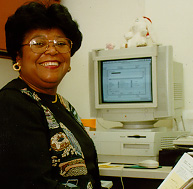
Mary Broadway, Medical Records Administrator,
Medical Record Department (MRD) |
From file clerk to supervisor, Boradway's done it all
Now, more than 37 years later, Mary prepares to retire from the CC and
her long and outstanding career with the Medical Record Department. Co-workers
marvel not only at her commitment to the department, but at her tenacity,
and strong desire to succeed. She worked her way up from entry level to
a professional level in the department.
"She has been an inspiration to me," said Jerry P. King, director
of the Medical Record Department. "She was always willing to place
herself in new environments and take on more responsibility and was known
as a role model for others in the department."
When she arrived to be interviewed for this article, her organizational
qualities were evident as she entered with notes in hand. Post-its, diagrams,
and handouts outlined her life and experiences in the Clinical Center. She
reminisced about the times when the campus had half as many building as
it does now, and even drew a picture showing how a compass sketched in the
ground of the main hallway helped her to learn her way around the often
confusing corridors of the hospital.
But it's the story of how she climbed the Medical Record Department ladder
that is truly an inspiration to everyone. She was hired in the research
and statistics section in 1960 and worked there until 1966 when she transferred
to the Department of Agriculture.
After 14 months, she returned to the record processing section of the
MRD. She obtained her accreditation as medical records technician through
a home-study program. Through years of persistence, King encouraged her
to come out of her comfort zone and accept a position with even more responsibility.
"He must have seen something in me that he felt made me right for this
promotion," said Mary. "Finally after years of trying to get out
of it, I accepted the position." She later became a physician liaison
in the record processing section, which is now known as the documentation
analysis and coding section. In 1989 she transferred into a professional
position with the credentialing and protocol services section.
According to Mary, her favorite professional experience was as a physician
liaison, where she was responsible for assuring that physicians met their
medical record documentation responsibilities. "I was the most comfortable
in that position," said Mary. "I think that's why it was my favorite."
Mary stressed the role of education in her professional life, and took
advantage of training opportunities at Montgomery College, George Washington
University, and the University of Maryland. But according to Mary, some
learning opportunities, such as public speaking and computers, were harder
for her than others. "When I attended computer classes, I was so excited,
overwhelmed, and anxious that it was almost impossible for me to grasp it
all," she said. "I later learned to slow down and evaluate the
steps in order to accomplish all of my educational goals."
Her fear of public speaking was quelled after being encouraged by King
to make presentations in front of the departmental staff. The speech classes
at George Washington University aided in her public speaking abilities.
During this period of time she learned to overcome her fear of speaking
in front of a group of people. "That incident taught me that public
speaking was an objective to be reached, not a path to be frightened by."
She also attributes her success to King, the MRD director, and the deputy
director, Jennifer Bayless, among others.
Mary plans to enroll in self-enrichment courses, and perform volunteer
duties with her church, the American Red Cross, and above all improve her
golf game. (by LaTonya Kittles)
index |
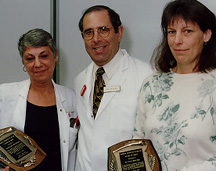
DTM staffers honored
Jacqueline Melpolder (left) and Jo Lynn Procter (right), DTM employees,
recently received NIH Merit Awards for their outstanding service and support
to clinical services, research, and patient care. Dr. Gallin presented the
honors last month. |
|
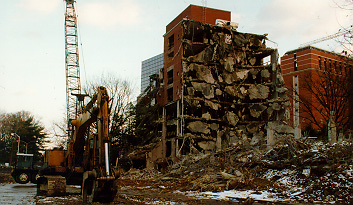
Farewell to building 20
Initial demolition of Building 20, which housed the former NIH Guest
House, has recently begun. The building will make way for construction of
the Mark O. Hatfield Clinical Research Center in coming months. Prior to
demolition, the building was used to assist local firefighters with firefighting
and rescue training.
index |
| |
Save
your register receipts from Safeway and Giant to benefit the NIH School
Program
Send
them to: NIH School Program, Building 10, Room 10S235. Or call 6-2077.
Program ends Feb.
28, 1998
index |
|
 |
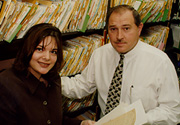
Medical forms for a patient dating back to 1956 were recently sent to
the Medical Record Department. Shown are Shannon Hall, (left) head of the
MRD records management section, and Jerry King (right) director of the department,
reviewing the documents.
|
Record sets a record?
If the Medical Record Department charged for overdue
records, some recently discovered forms dating back to 1956 would prove
quite costly.
The worn, brown records were anonymously forwarded to the department
in a messenger envelope and easily stood out from the thick stacks of loose
materials that are sent to the records management section every day.
"We usually receive patient records within one week of a visit,"
said Shannon Hall, head of the records management section. "So we thought
it was interesting that this record dated back over 40 years and there hasn't
been any patient activity over the past five."
Dr. Roscoe O. Brady, chief of the developmental and metabolic neurology
branch of the National Institute of Neurological Disorders and Stroke, knows
why that particular patient hasn't been back in the past few years. But
he's just as puzzled as everyone else about where the records have spent
the last 40 years.
It was under the care of Dr. Brady that this patient became the first
to be enrolled in a clinical trial involving metabolic storage disorder.
The clinical trial led to the identification of the defect in 1965 and the
discovery of an enzyme therapy in 1991.
Since then, the therapy has been approved and is administered by physicians
all around the world, including a private physician who now cares for this
patient close to home.
According to Hall, the record will be updated, if necessary, and microfilmed.
index |
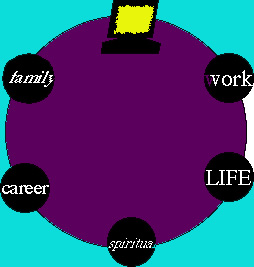
Breakthroughs to balance: learning to juggle
Balance. An interesting concept during a time of enormous change in the
Clinical Center. While parking, construction, and the like seem to be on
the minds of the NIH community, over 400 staff set aside time to attend
"Breakthroughs to Balance," a seminar held in Masur Auditorium
on December 11.
And as staff learned that the key to balance is making choices-many of
which involve sacrifices and consequences-they also learned how to balance
handouts on their laps, as they laughed, clapped, and listened to real-life
stories narrated by the guest speaker.
Michael P. Scott, a nationally known writer and motivational speaker,
has published over 50 articles and averages over 80 presentations each year.
But it wasn't just his credentials that made guests listen, it was his story.
Scott's early professional life involved working long and arduous hours
in an attempt to work his way up the ladder in the field of human resources.
After his mother was diagnosed with cancer, hospital bills for his daughter
topped $100,000, a troubled marriage and later divorce, and a relocation
and re-marriage, Scott recognized the need to make some hard choices in
his life.
"When I was stuck on a Chicago freeway in rush hour traffic, and
a sandwich truck driver put the doors up and started selling food, I realized
that I needed a change," he said.
It was then that Scott did what he says is hard for everyone, including
himself, to do-recognize the precise life changes that need to be made.
According to Scott, one of the most important things for people to do is
to search within themselves and identify the things in their lives that
are throwing them off balance. "The truth will set you free, but first
it will make you miserable," he said. His soul searching led him to
quit his job and pursue his current career.
The interactive seminar included lots of audience participation, and
attendees spent time discussing life issues with neighbors, learning the
major consequences of an unbalanced life, repeating phrases of encouragement,
and rewarding one another with high five's.
Scott discussed three major breakthroughs to balance. They include:
Life-direction breakthroughs
According to Scott, life-direction breakthroughs involve three major
areas:
- Develop a sense of mission and purpose by asking yourself "why"
you are doing what you do.
- Identify values by deciding what's important to you.
- Capture a vision based on your dreams, hopes, and aspirations.
"True commitment to a balanced life begins with a vision,"
said Scott. "Burnout occurs when you lose sight of your vision. Rustout
occurs when you never had one."
Chaos-management breakthroughs
In discussing chaos-management breakthroughs, attendees learned the
importance of planning ahead, saying no, asking for help, and taking advantage
of peak energy periods.
To avoid chaos, according to Scott, focus on the important things. Citing
the "Rule of 7," he said that people should focus on seven of
the most important things to get done.
"It is more important to list your priorities of items to accomplish
in a day rather than prioritize a long list of items."
Wellness breakthroughs
Wellness breakthroughs, according to Scott, may be the most critical
piece in a balanced life. He used statistics to support the claim that
many ailments are related to lifestyle, including diet and lack of exercise.
Attendees were advised to BURP (break up recurring patterns) by finding
other way of doing things, such as occasionally driving a different route
to work. "Variety is the spice of life and you need to change your
perspective on an ongoing basis," he said.
The event was sponsored by the NIH Quality of Work Life Committee and
the NIH Chapter of Blacks in Government, and presented by the NIH Federal
Credit Union and the NIH Recreation and Welfare Association. (by LaTonya
Kittles)
index |
From the director
by Dr. John I. Gallin, CC director |
If there's one word that describes our efforts over the past 12 months,
it's growth.
Groundbreaking ceremonies in November signaled the beginning of an era
of enormous physical growth for clinical research at NIH. We were honored
to have on hand that day a host of dignitaries, including Vice President
Al Gore, HHS Secretary Donna Shalala, and as the NIH community has pulled
together to define, refine, and finalize the design of our new building.
Through the CC Board of Governors and the NIH Clinical Center Advisory
Council, we have been able to build a tri-fold formula for good governance
that offers external oversight, impartial operational management, and strong
and crucial involvement of the institutes.
We have expanded our cooperative arrangement with Healthcare Management
Television's CenterNet and the Association of Academic Health Centers to
broadcast CC Grand Rounds to medical schools across the country. Joining
our regular audience early last year were the more than 1,000 hospital subscribers
to TiP-TV, a training and education network provided by GE Medical Systems.
In September, the CC Roundtable, featuring panel discussions by NIH experts,
was added to the network's lineup.
Last February, we offered a new venue for researchers to explore ideas
together when we co-hosted NIH's first Clinical Research Day. That event
celebrated the history of clinical research here and showcased current intramural
work.
Our ability to carry out and support intramural clinical research grew
in 1997 thanks in part to key staff appointments. New names and faces in
the CC family include Dr. Nick Bryan, who was appointed director of the
Department of Diagnostic Radiology and Clinical Center associate director
for radiologic imaging sciences. As associate director, Dr. Bryan, who came
here from Johns Hopkins, will oversee the Nuclear Medicine Department, the
PET Department, and the Laboratory of Diagnostic Radiology Research.
Michele T. Lagana, former assistant vice president and controller at
Providence Hospital in Washington, D.C., became our first chief financial
officer. Bioethics program recruits included Dr. Christine Grady, who serves
as the program's acting director, and Dr. Marion Danis from the University
of North Carolina School of Medicine. Maureen Gormley, formerly special
assistant to the CC director, was named chief of a new CC entity, the Office
of Administrative Management and Planning.
Also growing and evolving rapidly over the past year were projects established
to meet goals outlined in the Clinical Center's strategic plan, including:
Executive Information Systems. We awarded a contract to measure
how well existing information systems provide institute and CC managers
with accurate, timely online budget and management information. This program
will enhance our ability to work better, smarter, and more cost effectively
to support patient care and clinical research.
Contract Assimilation. We have looked closely at converting several
large contracts to in-house operations in order to save money while preserving
quality of care. Converting the contracts for PET technicians could save
up to $147,000 during the first year. Doing the same for the administrative
staff in the Department of Diagnostic Radiology is projected to save $124,000
the first year.
Core Course in Clinical Research. This study curriculum in how
to effectively conduct clinical research is about to enter its fifth year.
In 1997 the program grew to include more than 300 registrants. Also, lectures
now are video-conferenced to locations in Arizona, Montana, and North Carolina.
Hospital Alliances. This collaborative agreement with Johns Hopkins
and Suburban Hospital continues to evolve, and initial contacts for additional
affiliations have been made with Georgetown University Hospital, the National
Rehabilitation Hospital, and Children's National Medical Center. These alliances
broaden the clinical exposure of NIH clinical staff and provide intramural
investigators with access to patient populations not available at the Clinical
Center.
Protocol Coordination Service Center. This project provides centralized
and standardized support services for clinical research through an efficient,
timely, and responsive process over the four phases of a protocol.
Stem Cell Facility. This new facility, which opened last summer,
provides state-of-the-art research services to clinical investigators at
NIH exploring cellular therapies.
Telemedicine. This project is designed to increase patient participation
in clinical research studies from remote geographic locations; provide more
extensive patient follow-up, review, and consultation; and expand the resource
base of diagnostic and medical consultations. In 1997, we supported a clinical
trial to administer immune-enhancing therapy to patients with tuberculosis
in Harlingen, Texas, conducted three telesurgery pilots for training and
consultative review by NIH surgeons, and extended videoconferencing to allow
representatives from Australia to participate in international NIAID-sponsored
meetings for collaborators.
Protocols on the World Wide Web. This protocol database available
on the Clinical Center's home page (http://clinicalstudies.info.nih.gov/)
is used more and more every day by patients and referring physicians seeking
information on current clinical research studies. The clinical research
studies site now averages about 20,000 visits a week.
Clinical research initiatives. By working more efficiently, the
CC saved about $3 million in FY97. These savings will be reinvested through
a competitive selection process in clinical research initiatives of the
NIH institutes. This reinvestment will help stimulate grown in clinical
research during 1998 and beyond.
I am proud of the work we have done over the past year, work that would
not have been possible without dedication, tenacity, and vision. Those characteristics
run deep among CC staff and will be keys to our successes in 1998. index |
News briefs
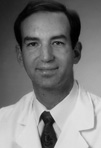
Whitcup elected group's chair
Dr. Scott Whitcup, clinical director of the National Eye Institute, has
been elected chairman of the Medical Executive Committee.
The committee develops and recommends policies governing standards of
clinical care in the hospital.
"Clearly the medical executive committee can play an important role
in making sure the NIH agenda of clinical research care is met," said
Whitcup. "I am looking forward to ensuring that the committee meets
these goals."
Initiatives planned by the committee include: quality of consultation
services regarding patient care, infrastructure for conducting clinical
research, and assuring that the new CRC meets the patient care and clinical
research needs of the intramural community.
Grady named to national academy
Christine Grady, acting chief of the Department of Clinical Bioethics,
has been elected to the American Academy of Nursing (AAN).
The AAN, which consists of 1,200 nursing leaders in education, management,
practice and research, was designed to anticipate national and international
trends in health care and address resulting issues of health-care knowledge
and policy. Grady was among 35 individuals chosen for 1997.
"Being a part of the Academy is a great honor in the field of nursing,"
said Grady. "The Academy will play an important leadership role in
the future of the field, and I hope to be a part of that."
Her clinical work, including over 14 years in the HIV clinical research
and treatment arena, as well as experience with NINR, was among the vast
criteria used to select her from a pool of more than 160 individuals.
Grady earned a bachelor's degree in nursing from Georgetown University,
a master's in community health from Boston College, and a Ph.D. in ethics
and philosophy from Georgetown. |
Not too late
The 1997 Combined Federal Campaign will officially end on Jan. 15. At
press time, the contributions were just a few thousand dollars short of
this year's $90,000 goal. If you are still interested in donating, please
contact your work site representative.
Clin path films holiday program
Clinical Pathology's hematology section recently filmed a Christmas carol
program featuring their Heme Team Jazz Ensemble and the CPD Chorale. A tape,
consisting of popular holiday songs, will be donated to the Children's Inn.
The ensemble consisted of Lynn Robertshaw, Dr. Candido Rivera, Dan Chao,
Jeb Monestarial, Alison Cooper, Monica Stankus, and Elena Stantaballa. Elizabeth
Chao conducted the group. Brenda Devrouax and Norma Ruschell provided AV
support.
Heart disease
Male volunteers over 40 years of age are needed for a study to assess
the effects of donating blood on prevention of heart disease. Participants
should have donated blood no more than once in each of the last five years,
and given fewer than 15 units in their lifetime. Blood studies and a carotid
ultrasound will be done. Two outpatient visits are required. For more information
call Xin Fu at 2-4482.
Board to meet
The CC Board of Governors will meet on Jan. 23 in the Medical Board Room
at 9 a.m.
Program honors Martin Luther King, Jr.
The annual program at NIH dedicated to Dr. Martin Luther King, Jr. has
been set for Friday, Jan. 16 at 11:30 a.m. in Masur Auditorium.
Martin Luther King III, son of the late civil rights activist, will be
the keynote speaker. All are encouraged to attend.
index |
| Clinical Center News,
6100 Executive Blvd., Suite 3C01, MSC 7511, National Institutes of Health,
Bethesda, Maryland 20892-7511. (301) 496-2563. Fax: 402-2984. Published
monthly for CC employees by the Office of Clinical Center Communications,
Colleen Henrichsen, chief. News, articles ideas, calendar events, letters,
and photographs are welcome. Deadline for submission is the second Monday
of each month. |
Editor: LaTonya
Kittles
top | cc home page
| nih home page | |
|





 Back to: Clinical Center Home Page > About the Clinical Center > News and Events